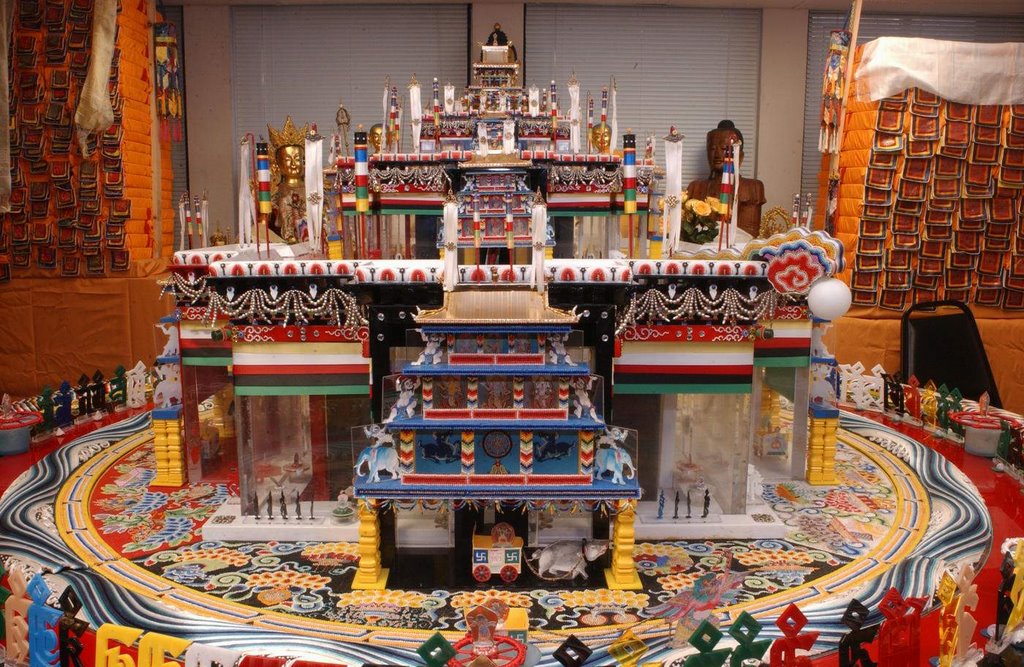
Happy Birthday to His Holiness the Fourteenth Dalai Lama, who was 72 (73 Tibetan) yesterday.

 The temperatures are approaching 126 degrees, the winds are regularly 60 mph or better, and then---in the middle of a clear day---lightning struck, touching off a 400 acre wildfire. Shades of last summer! The flagpole on the left in the above picture snapped off in the wind, so now we have another repair.


The British Library--surely one of the finest such institutions the world has ever known--is attempting to make over 100,000 items from Dunhuang available over the Internet. You can read all about this, here. The real thrill is that you can sponsor a sutra, just like the old days! I see that it will cost £1,107 to do the Vimalakirtinirdesa Sutra. This is the Chinese, but they also have numerous Tibetan works. Therefore, if you wish to sponsor a sutra in Tibetan, visit the above site. If I had more time, I would spend it studying the treasures found at Dunhuang.

News of a large statue of Guru Rinpoche recently moved at Samye Monastery calls to mind "Four Rivers, Six Ranges." This was the nominal designation of Tibetan guerillas based in Kham, who waged unsuccessful resistance warfare in the 1950s. This expenditure of blood and treasure... what did it gain? What I mean to say is that when you hear of such things, there is always this tendency to react...to aggressively wish something. But, we should stop and think. Getting angry at the Chinese doesn't help anything... planning reprisals doesn't help anything... shouting slogans doesn't help anything. Quite possibly, we don't know all the facts surrounding the Samye matter.
Then.. there is this quotation from H.H. Dalai Lama XIV:
"The ability to look at events from different perspectives can be very helpful. Then, practicing this, one can use certain experiences, certain tragedies, to develop a calmness of mind. One must realize that every phenomenon, every event, has different aspects. Everything is of a relative nature. For example, in my own case, I lost my country. From that viewpoint, it is very tragic--and there are even worse things. There's a lot of destruction happening in our country. That's a very negative thing. But if I look at the same event from another angle, I realize that as a refugee, I have another perspective. As a refugee there is no need for formalities, ceremony, protocol. If everything were status quo, if things were okay, then on a lot of occasions you merely go through the motions; you pretend. But when you are passing through desperate situations, there's no time to pretend. So from that angle, this tragic experience has been very useful to me. Also, being a refugee creates a lot of new opportunities for meeting with many people. People from different religious traditions, from different walks of life, those whom I may not have met had I remained in my country. So in that sense it's been very, very useful."

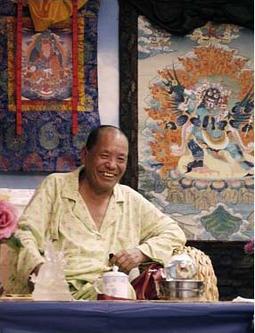
I learned that Pema Wangyal passed away.
I once commissioned him to paint two tangkhas: Longchenpa and Jigme Lingpa. I still have the Longchenpa tangkha hanging at the head of my bed. The one of Jigme Lingpa was lent to a student who now refuses to give it back.
Once upon a time, Pema was staying in San Francisco and we decided to have lunch together. When we finished, he sat down to paint and I sat idly by, picking my teeth and playing with the pots of colours. We were chatting about women---Pema had a string of blondes, and they were all becoming jealous of each other. He wanted me to intercede to keep the peace. Without thinking, I dipped my fingers into the blue and put my fingers on the wet toothpick, which I then placed in my mouth.
That was enough to stop my breathing.
One of the lamas came rushing into the room when he heard me choking, and Pema shouting that I had poisoned myself with the blue---cyanide---paint. The lama smacked me over the heart with his thumb and forced one of H.H. Karmapa's Precious Pills down my throat. Thereafter, with his fingers on my pulse, he asked me, "How do you feel?" I replied: "I don't care how I feel."
That is how effective the Precious Pills are.
I got the above photograph from Mike Dunham's blog. I hope the photographer will not mind if I include it here with this memory of my friend.
The review copy of my little booklet, Perfectly Natural Reaction: The Liberation of Small Creatures is now available for download here. We will keep this link active for awhile, with the provision that you write to me and tell me how you liked it, or did not like it, as the case may be.
NOTE: AS OF 23 FEBRUARY 2009 I HAVE TAKEN THIS OFF LINE.
YOU CAN WRITE AND REQUEST A COPY IF YOU LIKE.
When opportunity permits, we will be parking downloads somewhere
YOU CAN WRITE AND MAKE REQUESTS IF YOU LIKE.
 I am tremendously moved by the circumstances at the 500-year-old Nubri Monastery.
Friends have suggested that I provide a point of contact for people with questions. That is easy: rinpoche!(at)riversky(dot)org
Naturally, you would remove the exclamation mark before using this address.
His Eminence the Ninth Ogyen Tulku and Tenpa Rinpoche engaged in a White Mahakala Empowerment, 13 June 2007 (Ogyen Tulku did all the work and Tenpa Rinpoche just sat around doing nothing).

My new book, High Desert: Imitations of Meditation in America's Western Mojave, is now in pre-press. This will be available in September 2007 just about everywhere.
 Here is a scan of the original design for the Nyingma "Gesar" prayer flag commissioned by H.H. Tarthang Rinpoche circa the early 1970s. I seem to think this was drawn by somebody named Glen Eddy, but I could be wrong about that. Note the seal of the Tibetan Nyingmapa Meditation Center, at top, center.
 Above is not, strictly speaking, the first thing ever published by Dharma Press (now Dharma Publishing), but it is certainly among the first.
This picture by Sherab Palden Beru was published in August 1969, by Tarthang Rinpoche, on an Excelsior hand-powered printing press I helped to buy.
The original was published in the British magazine Middle Way, to illustrate an article by Trungpa Rinpoche.
I had the block done by M&H, in San Francisco. The gold for all of this came from washing dishes for USD $2.00 an hour at the Khyber Pass Restaurant, and whatever I could scrounge.
The signature at the bottom is that of H.H. Tarthang Rinpoche. This picture has survived fires, floods, and other disasters.
For the record, the first thing ever published by Dharma Press was a silkscreen work, and then, after the press was delivered, a little business card with the Seven Line Prayer.
 Here is another picture, of Milarepa, by Sherab Palden Beru, done in Scotland circa 1968.


Happy New Year to one and all. Here is a fascinating site devoted to Tibetan postal history, seals, banknotes, and other charming diversions. I hope your forthcoming year is prosperous and healthful.
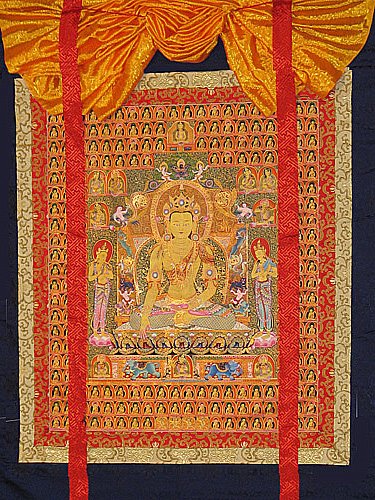
THE PRAYER OF
LIBERATING LIGHT
A Brief Practice to Benefit the
Victims of Sudden Death
by
Drugu Choegyal Rinpoche
with expanded commentary by
Urgyan Tenpa Rinpoche
Introduction
Beings who suffer violent death experience intense terror and illusion. This is particularly true of beings that die in wars, by weapons, by accident, or by suicide. Unless we act to help free them, their mind streams remain trapped in recurring cycles of long-lasting, fearful deceptions.
Recognizing that in the future such suffering would become prevalent, the Precious Lotus-born Guru, Padmasambhava, prescribed a prac-tice to awaken these beings. This practice then remained hidden for over six hundred years, awaiting the auspicious combination of circumstances for its revelation.
These circumstances came about in the fourteenth century, in the person of Lhodrag Namka Gyeltsen (1326-1402), a terma master of the Nyingma lineage, who discovered Padmasambhava’s concealed treasure and named it the prayer to Buddha Tsonchei Mijigpai Gyalpo.
In the twenty-first century, the eighth Drugu Choegyal Rinpoche composed a practice based on the revealed text, together with the oral com-mentaries of the eighth Khamtrul Rinpoche, and H.H. Dilgo Khyentse Rinpoche. In Choegyal Rinpoche’s practice, Padmasambhava’s prayer to Tsonchei Mijigpai Gyalpo is conjoined with invocations of Akshobhya and Vajrapani. According to Rinpoche, this is done in conformance with the Rinchen Terdzod, the Akshobya Sutra, and the Zungsnatsog of Jamgong Mipham Rinpoche. Choegyal Rinpoche then published his work with an explicit transmission permission and special request that all Buddhists adopt the practice to help the dead.
Unfortunately, we all know of someone who has died suddenly and violently. This may be someone we have heard about, or it may even be someone we know personally, such as a friend or family member. Our knowledge also extends to entire classes of beings, such as those who have died in a given war, a given sort of accident, or by a particular weapon.
Often, our knowledge of such matters leaves a lingering imprint upon our consciousness and moves the heart in strange directions. We wish there was something we could do; yet, because we do not know what action to take, we become troubled and this leaves a type of stain. We know, vaguely, that we are “for peace,” but we do not know how to express our intention in any spiritually meaningful way. If these circumstances apply to you, permit me to suggest that I know of no better counteragent to the practice of violence than the practice to liberate its victims.
In our present state of mind, we may not be able to completely accept that a prayer has the power to liberate victims of wars, accidents, and other forms of violence. However, we must learn to trust and accept a Buddha’s word---which has never been broken in thousands of years. For example: the past Buddha Ratnaketu made a specific vow, stating, “May all who hear my name be liberated from rebirth in the inferior existences.” Similarly, one of the twelve vows of the Medicine Buddha, Bhaisajyaguru Vaiduryaprabharaja, demands that just hearing his name protects beings.
Thus, the following practice, which invokes the Buddha Tsonchei Mijigpai Gyalpo to relieve suffering, the Buddha Akshobhya to mitigate karmic consequences, and the Bodhisattva Vajrapani to protect, may be confidently applied to any beings we know, or have heard about, at any distance, near or far. It does not matter if those who have died are Buddhists or not, nor does time and space play any role. There is no limit to a Buddha’s compassion and no limit to a Buddha’s power. Although we usefully apply this practice within the first seventy-two hours following death, and through the forty-nine days of the intermediate stage between death and rebirth, it is also equally beneficial when applied to the long deceased. This practice is so powerful it will reach beings no matter where they may be.
The Prayer of Liberating Light is a gift from the mind of a Buddha to the Buddha-mind of mankind, shepherded by the boundless compassion of the Nyingma lineage of Tibetan Buddhism, and the intention of Choegyal Rinpoche.
Still, there is always some unpleasant news to report. Because he is an unrepentant thief, and has a black gift for twisting language, the Rinpoche in name only, Urgyan Tenpa, arrogantly corrected the translation of Choegyal Rinpoche’s practice, and wrote this poor excuse for his actions. On the great lunar tenth feast day, 3 September 2006, he caused this to be composed in the English language and printed for all sentient beings.
Preliminaries
In the following liturgical text, I have used phonetics only where I am recording mantras or mantric syllables, or indigenously composed and culturally specific prayers. A perfect example is the famous Seven-Line Prayer. This is composed by Padmasambhava in seven lines of seven syllables, for future people in future times, to invoke Padmasambhava, who indeed founded Buddhism in Tibet.
In all other cases, I employ English. As this publication is primarily directed to those for whom English is the native language, it seems unnecessary and indeed counterproductive, to demand that the entire liturgy be performed in a language with which one has absolutely no connection. In such instance, one is mindlessly repeating sounds without any meaning. You may be confident that any Buddha, Bodhisattva, or Dakini can hear, understand, and respond to any language in which they are addressed.
Main Practice
Refuge (repeat three times)
namo ratna trayaya
I take refuge in the Tathagata Tsonchei Mijigpai Gyalpo, the Tathagata who liberates bardo beings from all fears and illusions arising from death by weapons.
I take refuge in the Tathagata Akshobhya.
I take refuge in Vajrapani.
Please pacify all the fears of those who have died in accidents and in war.
Arousing Bodhicitta (repeat three times)
To obtain Buddhahood for the benefit of others, I generate bodhicitta, as aspiration, as action, and in its absolute meaning.
Instructions and Visualizations
After you have recited the above, engage in meditation to generate profound feelings of compassion and equanimity toward all beings, without exception. Although this practice is primarily directed to humans, it is of immense benefit to all sentient beings. You can visualize yourself as Avalokiteshvara and recite OM MANI PADME HUM numerous times, until you are absolutely confident of your feelings.
Next, visualize the minds of those who have died in accidents and from weapons as blue balls of light, each enclosed by a surrounding sphere of violet light. While reciting the prayers and mantras hereafter, the violet spheres disappear and the minds, visualized as blue lights, are finally free. You may repeat the prayers and mantras below as many times as you wish, pausing for meditation between each in order to generate powerful feelings.
Prayer to Buddha Tsonchei Mijigpai Gyalpo
chom den dhe de shin sheg pa dra chom pa yang dag par dzog pai sang gye tsonchei mijigpai gyalpo la chak tsal lo, kyabsu chio. jin gyi lhab tu sol.
Bhagawan, Tathagata, Arhat, Perfect Buddha. The One who liberates bardo beings from all fears and illusions arising from death by weapons, we prostrate to you. We take refuge. Please bestow your protection and blessings to all who have died in this manner.
Dharani of Buddha Akshobya
namo ratna trayaya om kamkani kamkani rotsani rotsani trotrani trotrani trasani trasani pratihana pratihana sarva karma parampara nime sarva sato nanyatsa sowha
Mantra of Vajrapani
om vajra chandra maha roshana hum phat,
om aprati hata vala hum phat,
sarva bhiganan antaraya vinashkara maraya hum phat.
Conclusion
The whole of existence is perceived as filled with the five wisdom lights; the luminous radiance of the fearless wisdom, love, and compassion of the Buddhas of all times and directions.
We speak directly to the liberated minds of the deceased beings and we remind them that all phenomena are illusory, including our concepts of living and dying. We remind the Buddhists among them to think of Buddha Amitabha, who will bring whoever prays to him directly to the Pure Land.
The practice ends with a dedication of merit and recitation of a concluding prayer:
I dedicate the merit of this action to the welfare of all sentient beings wandering in samsara, enduring sufferings of all kinds. May each and every one be free of wrongdoings and illusions. Following the path to supreme liberation, may they become filled with boundless joy, happiness, and wisdom.
May the hail of lava, fiery stones, and weapons
Henceforth become a rain of blossoms.
May those whose hell it is to fight and wound
Be turned to lovers offering their flowers.
May forests where the leaves are blades and swords
Become sweet groves and pleasant woodland glades.
On every side and in all the ten directions,
May groves of wish-fulfilling trees abound,
Resounding with the sweetness of the Teachings,
Spoken by the Buddhas and their Bodhisattva children.
Choegyal Rinpoche’s Colophon
May this teaching spread around the whole world so that in these times of war the mind streams of the dead will become free from fearful illusions. By the merit of this teaching and practice, may the loving and compassionate quality of their minds arise with clarity so that they will be reborn in a peaceful world, in heaven, or in Buddha fields. MANGALAM.
Urgyan Tenpa Rinpoche’s Colphon
Every day in this world, delusion leads sentient beings to cause the death of each other, deliberately and by accident. This teaching, which has the power to liberate beings afflicted by the suffering born of such delusion, is dedicated to the welfare of all sentient beings, without exception. May it become for them a cause of happiness. May it never become a cause of sorrow. SAMAYA.
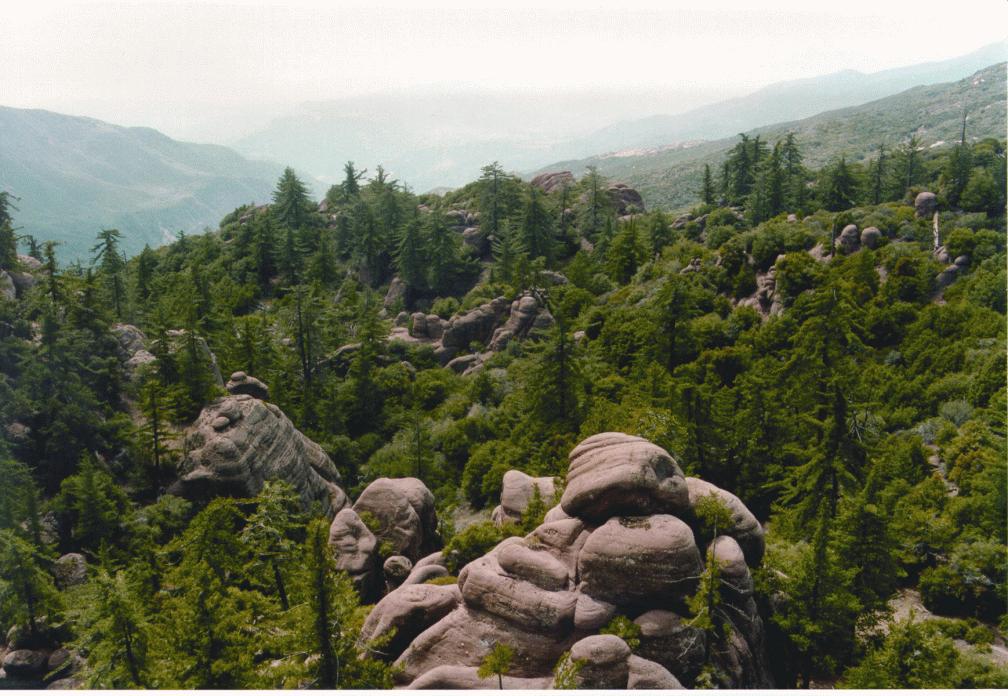
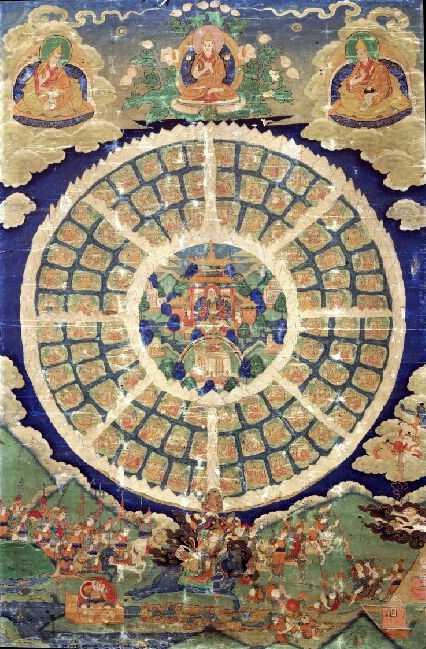
"Although those with special affiliation may actually be able to go there through their karmic connection, nevertheless it is not a physical place that we can actually find. We can only say that it is a pure land, a pure land in the human realm. And unless one has the merit and the actual karmic association, one cannot actually arrive there." --- H.H. XIV Dalai Lama, 1985.
 Somebody wanted to know more about the situation. As it stands now, 99,950 acres have burned: it will be well over 100,000 by the time you read this. Pine Mountain Buddhist Monastery has been evacuated, and most (about 90%) of the Wilderness is gone, along with more than half of the condor sanctuary. The air is "better," but because I am in the high risk group, I still have to stay indoors most of the time. The ecological effects of this unfortunate event will be felt for many years to come. You can say, with equal measure of grace and truth, that this is indeed an ecological disaster. Some people like to prattle on and on about "renewal," and "change," and so forth, and that is fine. But, a forest fire sparked by natural causes and a forest fire caused by a thoughtless idiot (as this one was), are two entirely different things. This thing burned up 50,000 acres in one night; last night it burned up another 10,000 or so, and it is only 35% contained. People hereabouts will see, in the future, that there are many changes. I am thinking that White Mahakala practice will be of use to everyone here.
The fire has turned away from us and is now threatening a Zen Buddhist retreat center north of here. Quick! Somebody pacify the renegade fire element that is running around threatening Buddhists! Actually, it seems there are singular forces at work. Scientists have discovered an unaccountable "hot spot" near here, where it is 584 degrees farenheit, eleven feet underground. This "hot spot" covers around three acres, and is inexplicable.
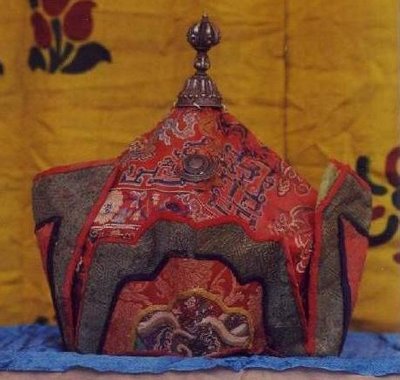


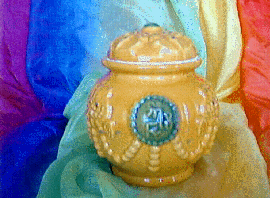
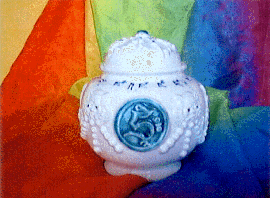
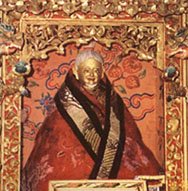
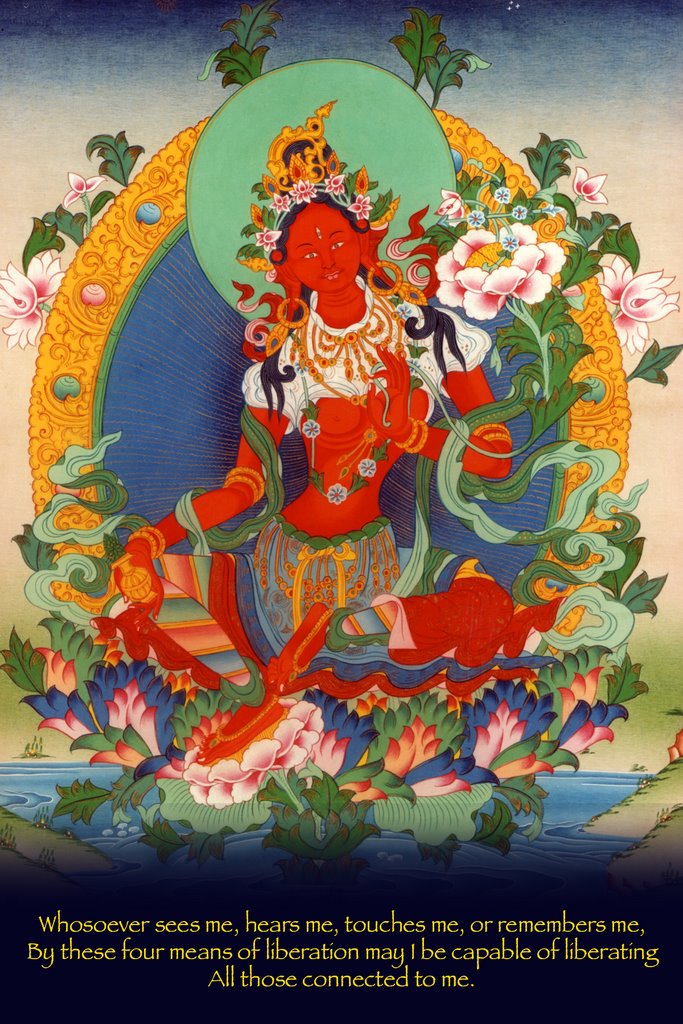 from Anyen Rinpoche's website:
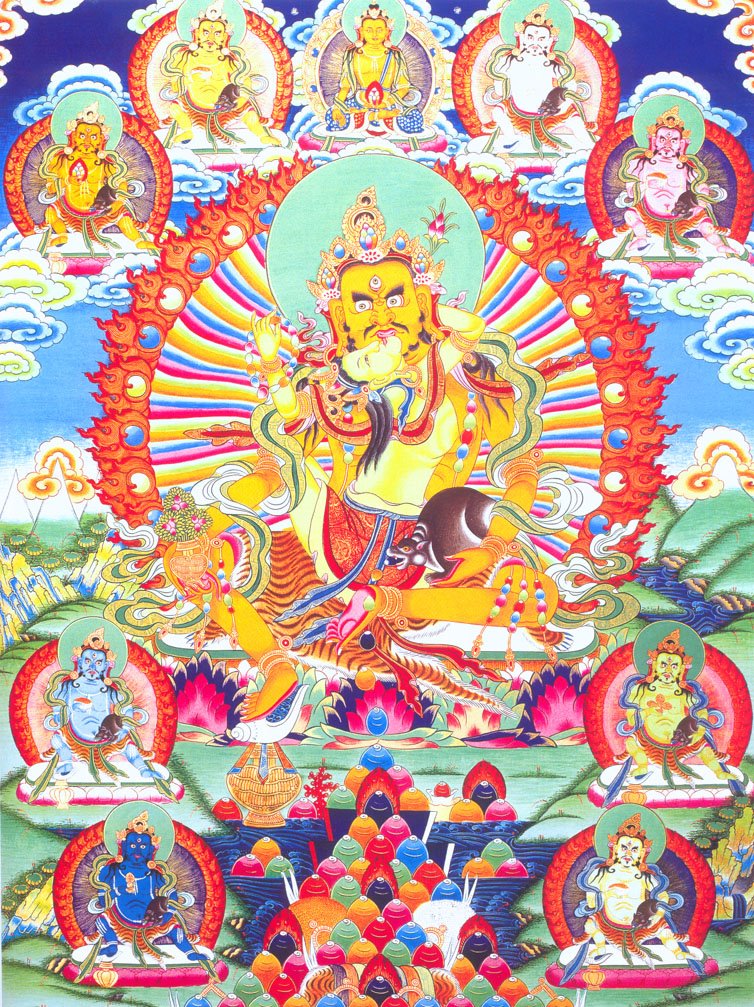 Orgyen Dzambala
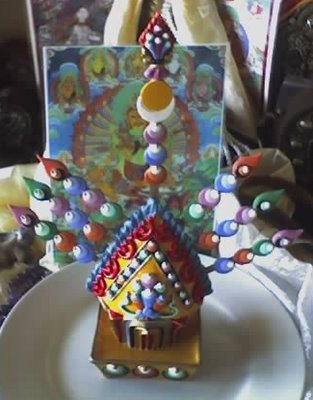 Dzambala torma on the traveling altar.
 H.H. Kusum Lingpa is doing a Orgyen Dzambala empowerment in Los Angeles this week, so it seems appropriate (Melong is attending, last night and today).
 There was a Swiss scientist, Dr. Hans Jenny (1904-1972) who built a device which allowed audio signals to animate matter and then record the results. The purpose was to study wave phenomena, which Jenny called "cymatics." Thus, above is Jenny's photograph of the vowel 'A' in sand. In other words, if you sort of beam the vowel 'A' at sand, the waveforms leave this result, which is very like a yantra. Now yantra is always considered the visible form of mantra, and this sort of photograph seems to be a kind of proof that the ancients knew what they were doing. I would like to see the results for OM AH HUM, so if anybody knows how to do this please let me know.